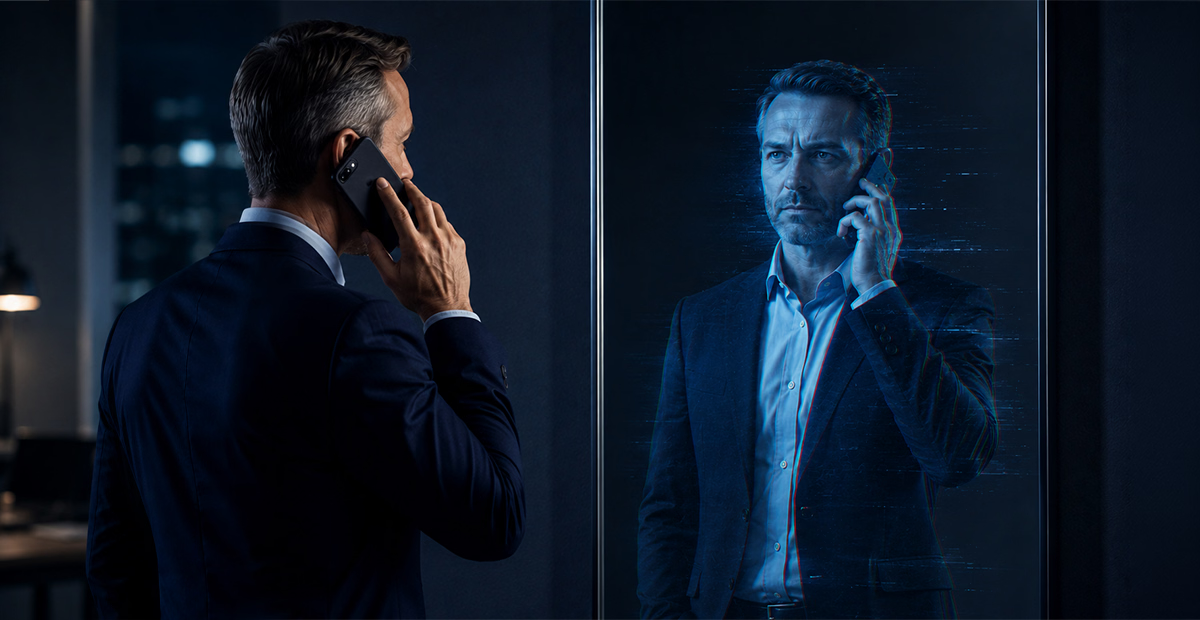
Three seconds. That’s all it takes. Three seconds of audio pulled from a LinkedIn video, a company webinar recording, or even your outgoing voicemail greeting, and a fraudster has everything they need to clone your voice. The clone can then call your family, your staff, sound exactly like you, and ask someone to authorize a wire transfer, hand over login credentials, or change a payroll account. AI voice cloning fraud has crossed from science fiction into a genuine operational threat for American small businesses. The FTC reported that imposter scams, the category that includes AI voice fraud, pulled around $3.5 billion out of Americans’ pockets in 2025 alone. And that figure only captures what people actually reported.
How AI Voice Cloning Fraud Actually Works
The mechanics matter because understanding them is the first step to defending against them. Voice cloning uses machine learning to generate synthetic speech that matches a specific person’s tone, cadence, accent, and even their breathing patterns. Attackers begin by collecting short audio samples from public sources, company websites, podcast appearances, recorded presentations, earnings calls, or social media posts. According to McAfee research, just three seconds of audio is enough to produce a voice clone with an 85% accuracy match to the original speaker.
That barrier has now collapsed entirely. As Fortune reported in December 2025, voice cloning technology has crossed what researchers call the “indistinguishable threshold”, meaning most human listeners can no longer reliably tell a cloned voice from the real one. In one study, human detection accuracy for high-quality deepfake audio dropped to below 25%. Your ear, in other words, is no longer a reliable security tool. Neither is your gut. And unfortunately, neither is your phone system, unless it’s built for this threat.
The Attacks Hitting Small Businesses Right Now
The playbook for AI voice cloning fraud at the small business level is well-established by now, and it’s getting more sophisticated every quarter. Here are the attack patterns showing up most in 2026.
CEO and executive impersonation
A fraudster clones the owner’s or CEO’s voice using publicly available audio. They call the office manager or a finance team member, usually at a busy moment, late in the day, or just before a holiday, and request an urgent payment, vendor change, or fund transfer. Security researchers estimate that CEO fraud now targets at least 400 companies every single day in the US. The FBI’s Internet Crime Complaint Center (IC3) logged more than 22,000 AI-related fraud complaints in 2025, with losses exceeding $893 million, and experts widely consider that figure a dramatic undercount, since fewer than 5% of victims report their losses.
Vendor payment redirect
Here the attacker clones the voice of a known supplier or partner. They call your accounts payable contact, reference a real invoice number pulled from a prior data exposure or phishing email, and request updated banking details for an upcoming payment. The call sounds legitimate because the voice matches perfectly. The next ACH transfer goes to a fraudster’s account.
IT helpdesk credential harvesting
Cloned voices of IT managers or managed service providers are increasingly used to call employees directly. The script typically involves a “security alert” requiring the employee to reset a password, read out a multi-factor authentication (MFA) code, or install remote access software. By the time anyone realizes what happened, the attacker is already inside the network.
Your Digital Voice Footprint Is Larger Than You Think
Most business owners don’t think of their voice as a security credential. They should. Over 53% of people share voice recordings online at least once a week, according to industry research. Every webinar you’ve hosted, every video testimonial you’ve recorded, every podcast you’ve appeared on, those are potential audio harvesting sources for a patient attacker.
The regulatory response is real, but still catching up. The FCC ruled in February 2024 that AI-generated voices used in robocalls qualify as “artificial or prerecorded voices” under the Telephone Consumer Protection Act (TCPA), making their fraudulent use explicitly illegal under existing robocall law. The FBI has issued multiple public warnings about criminals leveraging cloned voices to target both businesses and individuals. These are the right moves. They just don’t prevent an attacker from making the call before anyone stops them.
That’s the uncomfortable truth about AI voice cloning fraud in 2026: the legal framework exists, the awareness is growing, and the attacks are still succeeding. The gap sits squarely at the technology and process level inside businesses themselves. Most phone systems weren’t designed to handle a threat that didn’t exist five years ago.
What a Modern Business Phone System Should Be Doing About It
Your phone system isn’t just a communications tool anymore. In 2026, it’s a frontline fraud defense layer, or it should be. Here’s what the right platform does.
Carrier-level call authentication
Your VoIP provider must be fully compliant with the FCC’s STIR/SHAKEN call authentication framework. STIR stands for Secure Telephone Identity Revisited; SHAKEN stands for Signature-based Handling of Asserted Information Using toKENs. Together, they digitally sign calls so the receiving carrier can verify the caller ID hasn’t been spoofed. Full compliance, using the provider’s own Service Provider Code token and certificate, not a third-party workaround, is a legal requirement since September 2025. If your provider can’t confirm this directly, switch. A fully compliant business phone system is table stakes at this point, not a premium feature.
AI-powered inbound call screening
AI Voice Agents, intelligent Interactive Voice Response (IVR) systems that hold natural, two-way conversations, are increasingly used by businesses as a smart front-of-house for inbound calls. A well-configured AI Voice Agent can verify caller intent, collect identifying information, and route only validated calls to human staff. This doesn’t eliminate AI voice cloning fraud risk, but it removes the element of surprise. An attacker trying to clone your CFO’s voice to reach your payroll manager has a much harder job when the first interaction is with a system designed to interrogate, not trust. See how 2talk’s AI Voice Agents work as a smart call screening layer for your business.
Out-of-band verification as a standing policy
Technology handles the infrastructure layer. Policy handles the human layer. Every request received by voice, whether for a payment, a credential, a system change, or access to sensitive information, should require verification through a second, independent channel. Call the person back on a known number. Send a text. Check via your internal messaging system. Establish a code word that only real executives would know for urgent financial requests. Organizations that implement these verification protocols reduce voice fraud success rates by up to 46%, according to industry research. The protocol costs nothing to implement. The call it stops could save your business six figures.
The Provider Choice Is Part of the Defense
Small businesses often choose a phone provider based on monthly cost. That’s understandable, saving up to 80% compared to legacy phone systems is a genuine business win. But the provider you choose also determines your fraud exposure. Does your current provider operate STIR/SHAKEN with their own certificate? Do they give you call analytics you can actually read? Do they offer AI-powered call handling that can act as a buffer between fraudsters and your staff? These questions matter as much as the line rate.
At 2talk, we’ve built our platform around real infrastructure that serves 10,000+ US businesses, not resold wholesale capacity with a branded portal on top. We’ve won the Internet Telephony Excellence Award three years running, and we operate with no lock-in contracts and fully transparent pricing. When you call us with a fraud concern, you talk to someone who actually knows how the network works.
AI voice cloning fraud is not a future threat. It’s active, it’s cheap to run, and it’s getting more convincing every quarter. The businesses that defend against it successfully are the ones that took their phone infrastructure seriously before the call came in.
If you want an honest conversation about where your business phone setup stands today, reach out to the 2talk team. No pitch, no pressure, just straight answers from people who’ve run real telco infrastructure at scale.