Today is World Environment Day 2026. This year’s theme, #NowForClimate, is a call from the United Nations Environment Programme (UNEP) for businesses and individuals to stop planning and start acting on climate. It’s a message I genuinely believe in. And here’s the thing: one of the most practical, immediate climate actions your business can take has nothing to do with solar panels or electric vehicles. It’s your phone system. The cloud phone system environmental impact is real, measurable, and frankly underappreciated. If your business is still running an on-premises Private Branch Exchange, a PBX, the physical hardware box that used to manage your office calls, you’re carrying a hidden environmental cost that most people never add up.
Let me walk you through what that cost actually looks like, and why moving to a cloud-based Voice over Internet Protocol (VoIP) phone system is one of the smarter climate moves a small or mid-sized business can make right now.
The Hidden Weight of On-Premises Phone Hardware
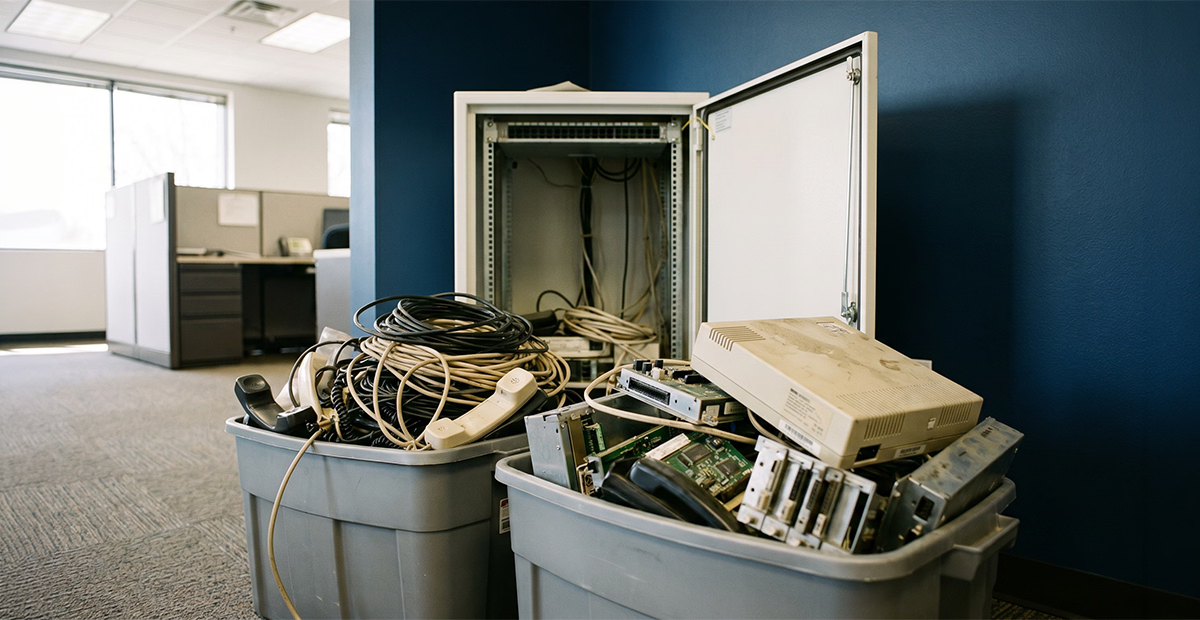
Walk into the phone closet of any business still running legacy telecommunications equipment, and you’ll find a graveyard of hardware. There’s the PBX unit itself, a dedicated server that runs your call routing. There are the physical desk phones wired to a proprietary network. There’s the power-hungry Uninterruptible Power Supply keeping it all alive through outages. Add in the network switches, cabling, expansion cards, and the occasional modem that nobody can explain anymore. Every one of those devices draws continuous power, generates heat, requires physical maintenance, and eventually dies.
On-premises PBX systems typically last between five and fifteen years. When they reach end of life, they become electronic waste, commonly called e-waste, and that’s where the environmental problem gets serious. Legacy PBX hardware contains lead, brominated flame retardants, and lithium batteries. These materials require careful handling. In practice, they often don’t get it.
The scale of the global e-waste problem is hard to overstate. The United States is one of the world’s largest producers of electronic waste, with a recycling rate below 16%, according to UN data. Globally, the world produced 62 million tons of e-waste in 2022, up 82% from 2010, and the UN’s Global E-Waste Monitor 2024 projects that number will reach 82 million tons by 2030. That’s a staggering amount of discarded circuit boards, power supplies, and proprietary handsets heading toward landfills and informal recycling operations that release toxic materials into soil and groundwater.
Your old PBX is part of that story. So is every desk phone tethered to it.
What Cloud Phone Systems Actually Change
When you move your business communications to a cloud phone system, the physical hardware equation changes dramatically. Your call processing, voicemail, auto-attendant (the Interactive Voice Response, or IVR, system that answers and routes calls), call recording, and every other feature you rely on moves to a shared data center. You don’t own or maintain that infrastructure. You don’t replace it on a seven-year cycle. And critically, you don’t dispose of it.
The cloud phone system environmental impact stems from a concept called resource pooling. Thousands of businesses share the compute power of a single data center instead of each running their own dedicated server. That shared infrastructure operates at much higher efficiency than the average on-premises PBX sitting in a room with inadequate cooling and utilization rates below 20%.
A 2021 forecast from research firm IDC projected that the global shift from on-premises systems to cloud computing could prevent more than one billion metric tons of carbon dioxide emissions between 2021 and 2024, assuming continued adoption of more efficient, sustainable data center practices. That’s not a rounding error. Even at the lower bound of IDC’s model, migration to the cloud alone was projected to save 629 million metric tons over that period. That’s the direct result of higher efficiency through aggregation: doing more with less hardware, less energy, and less waste.
For small businesses specifically, the carbon math is compelling. Studies suggest that small businesses moving workloads to the cloud can reduce their per-user carbon footprint by up to 90% compared to equivalent on-premises infrastructure. Large enterprises see reductions closer to 30%. The gap makes sense: small businesses tend to run hardware at lower utilization rates, so the efficiency gains from shared cloud infrastructure are proportionally larger.
Fewer Devices. Smaller Footprint.
Cloud VoIP doesn’t just move processing off-site. It also reduces how many physical devices your business needs in the first place. Here’s a concrete example. A business running an on-premises PBX typically has:
- A dedicated PBX server or appliance
- Proprietary desk phones for every employee
- Physical network switches wired specifically for voice traffic
- Backup power hardware
- Potentially gateway devices to connect legacy analog lines
Switch to a cloud phone system like 2talk, and most of that disappears. Your employees use a softphone app on the laptop or smartphone they already own. Or they keep a single IP desk phone, a standard one rather than a proprietary model locked to one vendor, if they prefer a physical handset. Either way, you’re eliminating multiple categories of hardware from your office entirely.
At 2talk, the softphone app on your existing phone or computer is your phone system. For businesses that still want desk phones, our Business Phone System works with standard IP handsets rather than proprietary hardware ecosystems that create vendor lock-in and accelerated device obsolescence. And for businesses with older analog equipment they need to preserve, our FLIP™ VoIP Gateways extend the life of existing hardware rather than replacing it, which is genuinely the greener option in the short term.
The On-Premises Vendor Exodus Tells the Real Story
If you needed any more evidence that on-premises phone hardware has a shelf life problem, look at what the manufacturers themselves are doing. Panasonic discontinued its PBX systems in 2023. Toshiba exited the market in 2021. NEC stopped taking orders for US on-premises systems in 2024. Avaya’s Aura platform reached end of life in 2023. These are not fringe players. They are the companies that built the hardware sitting in phone closets across America right now.
When a vendor exits, support ends. Security patches stop. The hardware keeps running, drawing power and generating heat, until it fails. Then it becomes e-waste without a clear upgrade path and often without a clear recycling pathway either. Businesses caught in this cycle face two problems at once: operational risk and environmental liability.
The cloud doesn’t have this problem. Infrastructure upgrades happen at the provider level, transparently, without requiring you to buy new hardware, schedule a technician, or dispose of anything.
Sustainability Is a Business Decision, Not Just a Values Statement
I want to be direct here. The cloud phone system environmental impact argument is compelling on its merits, but for most SMB owners, it’s the operational and cost case that closes the deal, and that’s completely fine. The environmental benefits come along for the ride.
Switching from an on-premises PBX to a cloud-based system typically cuts business phone costs by up to 80%. There are no hardware refresh cycles to budget for. No maintenance contracts on aging equipment. No specialist to call when the PBX goes down at 7 PM on a Friday. The system scales as your team grows or shrinks, without buying and disposing of hardware at every inflection point.
That scalability is itself an environmental win. On-premises hardware gets purchased for peak capacity and then runs at whatever utilization you actually need, wasting energy for the gap. Cloud infrastructure scales to match actual demand. You’re not paying for, or burning energy on, hardware headroom you don’t need.
At 2talk, we serve over 10,000 US businesses with no lock-in contracts and transparent pricing. Our UCaaS platform, Unified Communications as a Service, meaning calls, chat, and meetings in one system, replaces multiple layers of hardware with a single cloud service. One subscription. No closet full of equipment. No disposal problem on the back end.
What You Can Do Today
World Environment Day 2026 is a useful moment to audit the actual environmental footprint of your business infrastructure. Your phone system is a practical place to start. Ask yourself:
- How old is your on-premises PBX, and is your vendor still actively supporting it?
- How many physical devices, including servers, switches, and handsets, does your phone system require?
- What is your plan when that hardware reaches end of life?
- Could your team do the same job using a softphone app on existing devices?
If the answers make you uncomfortable, that’s useful information. The cloud phone system environmental impact advantage is real, but it only materializes if you make the switch. Hardware sitting in a closet doesn’t get greener with age.
The EPA’s electronics stewardship program, Sustainable Management of Electronics, offers resources for responsible disposal of existing hardware when you do make the transition. That’s worth bookmarking.
For further reading on how cloud communications compare to legacy systems in real-world deployments, the IDC research library is a solid starting point. Their cloud infrastructure work is thorough and data-driven.
The Signal Your Business Can Send
UNEP’s theme this year is about signals: the signals the planet is sending us, and the signals we choose to send back. Replacing aging, energy-hungry, waste-generating phone hardware with a cloud system is a small signal. But multiply it across the tens of thousands of US businesses still running on-premises PBX gear, and it adds up to something meaningful.
I’ve spent nearly 20 years in telecommunications. I’ve watched the on-premises hardware cycle chew through budgets and generate mountains of proprietary waste. Cloud communications don’t just perform better and cost less. They genuinely produce less physical waste. That matters, and it’s worth saying plainly on a day like today.
If you’re ready to talk through what moving to a cloud phone system would actually look like for your business, including what to do with the hardware you’re replacing, reach out to the team at 2talk. No pressure, no jargon. Just a straight conversation about what works for your business and your budget.